
How to choose the right squeegee blade for your screen printing?
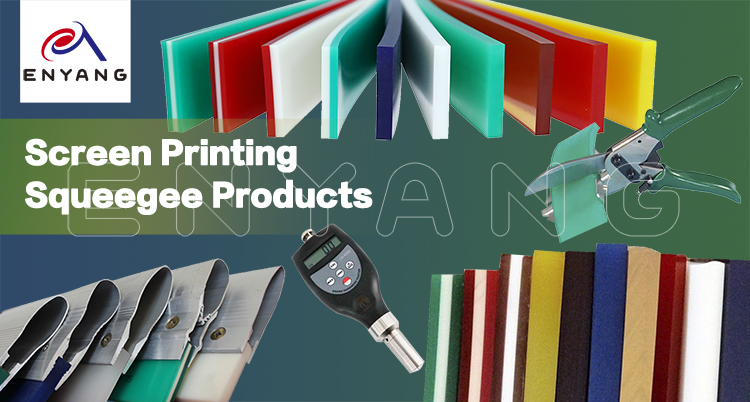
How to choose the right squeegee blade for your screen printing?
Your choice of squeegee for silk screen can significantly influence your printing results – ensure you select the right one for your specific needs!
Squeegee Rubber Shape
The tip of the mono-filament squeegee blade comes in various shapes:
Square – or straight-edge also called flat shape – squeegee blades have a flat cut across the bottom. These are the most commonly used squeegee blades and are suitable for a wide range of screen printing applications.
Round – or ball-nose – squeegees are utilized when printers require a thicker layer of ink, such as when working with heavier substrates or using specialty inks.
Beveled squeegees-or V shape- feature an angled edge on one or both sides of the blade. Beveled blades are typically employed when printing on curved or uneven surfaces.
Standard Profiles: E1-E9
E1: Straight Square Edge
E2: Single Bevel+Flat tip
E3: Single Bevel
E4: Double Bevel + Flat tip
E5: Double Bevel (V shape)
E6: Bull Nose (Round Top)
E7: H Shape
E8: Triple Layer
E9: Double Layer

Squegee Rubber Rigidity
The rigidity of a squeegee is measured by durometer, with higher durometer values indicating a harder blade. Harder squeegee blades shear the ink more effectively, while softer squeegees tend to leave a thicker ink deposit.
Squeegees within the 50 to 60 durometer range are classified as soft squeegees. They are ideal for achieving heavy ink deposits when printing on thick substrates, controlling fibrillation, or working with specialty inks.
The most commonly utilized squeegees have a durometer of 70. These are regarded as medium hardness and are suitable for most general screen printing tasks.
Hard or ultra-hard squeegees, which range from 80 to 90 durometer, are designed to leave a lighter ink deposit. They are perfect for use with high mesh count screens, for fine detail printing, or for executing four-color process jobs.
Additionally, there are composite squeegee blades that incorporate layers of varying durometers. The printing edge consists of a lower durometer for smooth contact with the screen, while a higher durometer layer provides strength to prevent the squeegee from bending and losing its shape.
Squeegee durometer chart
|
Soft |
55,60,65 |
Shore A |
Red or Natural |
|
Medium |
70,75 |
Shore A |
Green or Natural |
|
Hard |
80,85 |
Shore A |
Blue or Natural |
|
Super hard |
90,95 |
Shore A |
White |
|
Triple medium |
75/90/75 |
Shore A |
Green/White/Green |
|
Triple soft |
65/90/65 |
Shore A |
Red/White/Red |
Silk Screen Printing Squeegee Materials
Squeegees can be constructed from natural rubber, neoprene, or polyurethane.
Traditionally, squeegees were crafted from natural rubber. While rubber blades are more affordable than other types, they have become less popular due to their tendency to absorb solvents and deteriorate quickly.
Neoprene blades are pricier than rubber but more economical than polyurethane blades. Neoprene is a favored choice for squeegees because it resists degradation better than rubber blades.
Polyurethane squeegee blades represent the highest cost option, yet they offer the greatest durability. These blades are typically utilized for tasks that require extended periods and are used with automatic or semi-automatic printing presses.
Selecting the Appropriate Squeegees for yourself
Enyang squeegee blades are made from durable polyurethane and can be tailored to meet your specific requirements.
Squeegee Rubber Types
HD Series Squeegee
The standard formula design, good solvent resistance, and abrasion resistance, according to one of the testing of any single four blade can bear a print load, thousands of times more cost-effective outstanding; Suitable for electronic, optical, ceramics, advertisements, liquid crystal display, membrane switch, glassware, textile and other all of screen printing, moderate price, suitable for any printing occasion, it is the most widely used products for customers.
Its feature include Good solvent-resistance and abrasion resistance; Easy to grind, repeated use, cost saving; In solvent, low expansion rate and less deformation; Good elasticity, remaining on the screen of the pression in the process of printing, precision printing.
MD Series Suqeegee
This product has the special design, the texture are extremely dense and strong, even after using it in the solvent for thousands of times, still could retain the edge full smooth. It is suitable for large-scale automated production lines; In addition, stictly control the production process, so as to ensure the convenience and security in the printing production. It has the good solvent resistance and abrasion resistance and long life time in polyurethane products line; Polyurethane squeegee with excellent comprehensive perfprmances that praised by users.
Its features include Ultra sharp printing edge; Excellent print quality and accuracy; Good ink transfer properties; Less ink used and screen breakages;High resistant to abrasion; Longer squeegee life; Low absorption form chemicals in ink systems; Printing longer; Consistant product quality and stable printing quality.

Screen Printing Squeegee Handle
For manual screen printers, the choice of squeegee handle is crucial. You want a handle that can withstand the demands of printing while also feeling comfortable in your hand.
Wooden handles are a classic choice due to their warmth and comfort. However, they tend to absorb moisture and solvents, making them challenging—if not impossible—to clean. Additionally, replacing squeegee blades with wooden handles can often be more complicated. Wooden handle is suitable for manual screen printing, our wooden handle is made of light material, has good abrasion resistance, and has good performances in water and oil printing.
On the other hand, plastic or aluminum handles are easy to clean, and swapping out blades is typically quick and straightforward. Look for handles with an ergonomic design that fits comfortably in your hand. Aluminium handle has light weight, after oxidation treatment, it has strong corrosion resistance, aluminum handle can be used repeately. When using the aluminium handle squeegee, first you can cut it into the right length, then put it in the slot of aluminium handle, tighten the screws on the aluminium handle, and finally can be used.

Other Squeegee Rubber Considerations
Regardless of the squeegee you choose for your printing tasks, there are several important factors to consider.
Blade Width – The squeegee blade should extend approximately one inch beyond your artwork on either side; however, it should not come too close to the frame of your screen, as this can compromise the screen tension.
Blade Condition – Squeegee blades can develop nicks or warp over time. Due to the abrasive nature of the screens, they will dull with use. Ensure your squeegee is in good condition and free from warping or damage, as this can impact your print quality.
Squeegee Care – Blades tend to absorb moisture and solvents. Avoid letting blades sit in a solution, clean them promptly after use, and maintain a sufficient supply of squeegee blades to allow for rotation, giving each blade adequate time to dry between jobs.
By understanding how each variable of the squeegee affects your overall print, you can select the appropriate squeegee for each screen printing task. The right squeegee, combined with proper care, will enhance your screen printing results.
For more details for screen printing squeegee, please contact us at +86 15097355251
What is Backlit Film and How Backlit Film Works?
Common Screen Printing Ink Type
Related Article


