
HOW TO CHOOSE A SQUEEGEE
2025-05-29
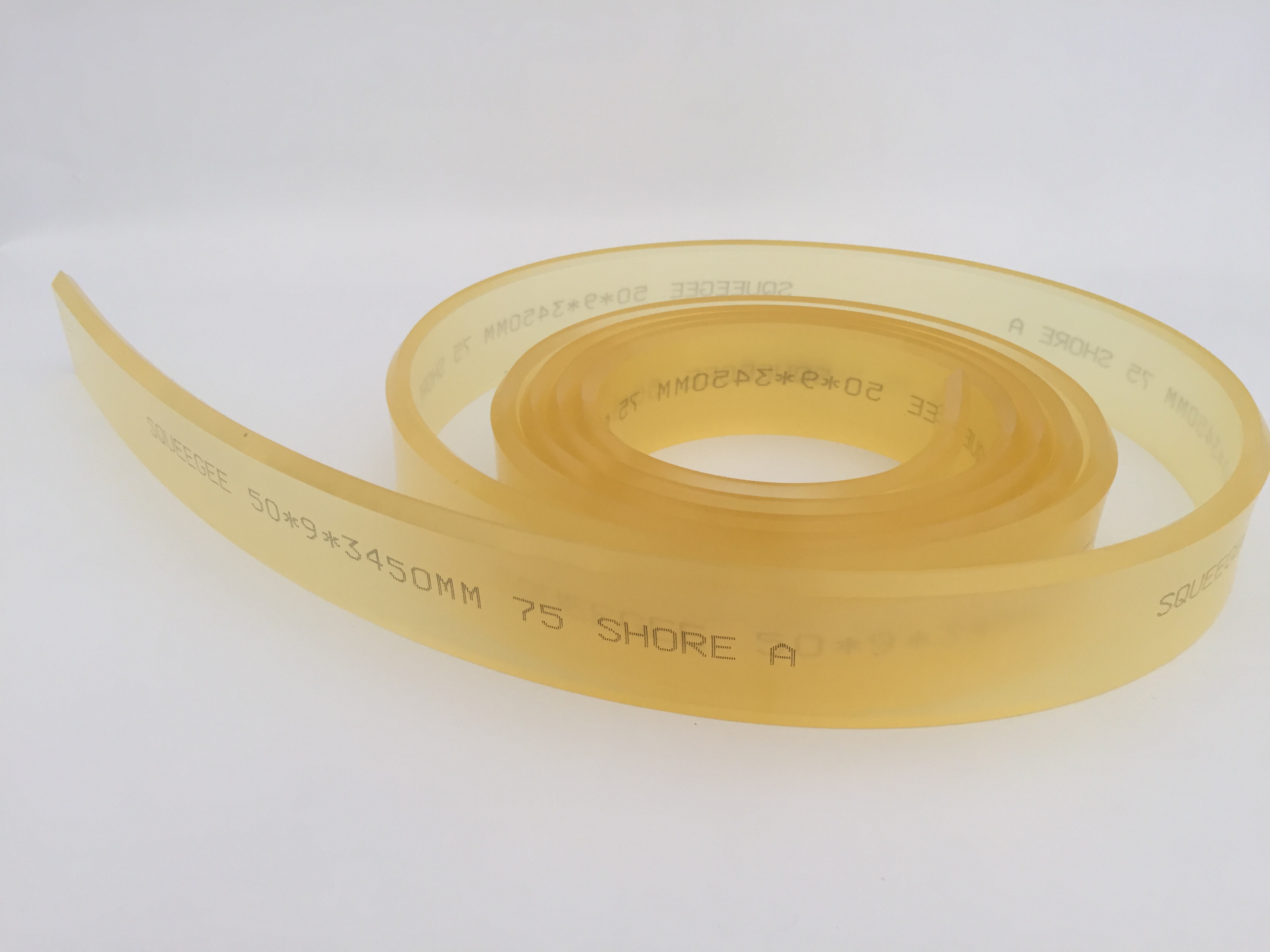
HOW TO CHOOSE A SQUEEGEE?
To choose the right squeegee, consider the surface you're cleaning, the size and shape of the surface, and the type of material you're using.
For screen printing, think about the durometer (blade hardness) and the blade shape to match your print design and substrate.
For cleaning, consider the material of the blade and handle, as well as the overall size and design.
65 SH squeegees are very soft and are usually used to print on ceramic and with glitter inks.
75 SH squeegees are recommended for printing on glass and on garments.
85 SH squeegees are used to print with high-speed automatic machines, to print on CDs, credit cards, electronic circuits, small objects,
where high precision is required.
SURFACE: If the item you have to print has a rough, non-planar surface, the most suitable squeegee durometer is between 60 and 70 sh.
If the surface is smooth, a harder durometer squeegee, between 80 and 90, should be used.
MESH: if a high mesh count (a very thin mesh!) is being used, you need a harder squeegee (80 or 90 sh); if you are printing with glitter ink
(which has large flakes of shiny, plastic material that have to pass through the mesh) you should use a softer squeegee.
INKS: The more aggressive inks, such as UV inks, damage the squeegee more than a standard water based ink. The harder the squeegee,
the more solvent resistant the blade. Therefore, to eliminate swelling and chemical breakdown, use a harder durometer squeegee
INK DEPOSIT: A soft squeegee will deposit a thicker layer of ink than a harder squeegee.
AUTOMATIC OR MANUAL: Hard durometer squeegees are normally used on high speed automatic machines (high degree of abrasion
that occurs during a production run). Softer durometer squeegees are typically used for low-pressure low-speed manual and
semi-automatic presses.
65 SH squeegees are very soft and are usually used to print on ceramic and with glitter inks.
75 SH squeegees are recommended for printing on glass and on garments.
85 SH squeegees are used to print with high-speed automatic machines, to print on CDs, credit cards, electronic circuits, small objects,
where high precision is required.
SURFACE: If the item you have to print has a rough, non-planar surface, the most suitable squeegee durometer is between 60 and 70 sh.
If the surface is smooth, a harder durometer squeegee, between 80 and 90, should be used.
MESH: if a high mesh count (a very thin mesh!) is being used, you need a harder squeegee (80 or 90 sh); if you are printing with glitter ink
(which has large flakes of shiny, plastic material that have to pass through the mesh) you should use a softer squeegee.
INKS: The more aggressive inks, such as UV inks, damage the squeegee more than a standard water based ink. The harder the squeegee,
the more solvent resistant the blade. Therefore, to eliminate swelling and chemical breakdown, use a harder durometer squeegee
INK DEPOSIT: A soft squeegee will deposit a thicker layer of ink than a harder squeegee.
AUTOMATIC OR MANUAL: Hard durometer squeegees are normally used on high speed automatic machines (high degree of abrasion
that occurs during a production run). Softer durometer squeegees are typically used for low-pressure low-speed manual and
semi-automatic presses.

DOUBLE AND TRIPLE-LAYER SQUEEGEES
In double- and triple-layer squeegees, the squeegee has a soft print edge, and a rigid backing material supporting it.
Double-layer squeegees grant higher quality in printing even where it is necessary to print with a soft blade. The hard layer increases the
stability of the squeegee.
In triple-layer squeegees, the hard core of the triple-layer squeegee further improves precision, even in fast automatic printing: it gives
stability to the squeegee even if you need to print with a soft squeegee - i.e.: 65/90/65 sh is soft but very stable.
HARDNESS: from 35 sh A to 65 sh A, light blue color
SPECIAL SQUEEGEES: double and triple layer
LENGTH: mm 3660, mm 3050 or cut to size
WIDTH: from 20 mm up to 100 mm
THICKNESS: from mm 4 up to mm 10
SPECIAL SQUEEGEES: double and triple layer
LENGTH: mm 3660, mm 3050 or cut to size
WIDTH: from 20 mm up to 100 mm
THICKNESS: from mm 4 up to mm 10
If you want more details, please contact us at +86 15097355251
What is the pallet tape?
Printing and dyeing solutions
Related Article

This article analyzes the pricing logic of screen printing in the European and American markets, breaking down key cost factors such as plate-making fees, pre-press processing, order volume, color techniques, substrates, and additional service charges. It outlines reference pricing ranges for each stage, providing brands and buyers with valuable guidance for quotation inquiries and budget planning.
How much does screen printing usually cost?

Complete guide for 40*48 cold light exposure machine in screen printing. Learn standard operation steps, parameter setting, troubleshooting, and daily maintenance to improve stencil making accuracy and yield for screen printing production.
The Ultimate Guide of Screen Printing Exposure Unit

This article focuses on selecting screen printing frame stretching machines. It explains key purchasing considerations—including print area, drive system, clamping mechanisms, configuration, and operation and maintenance—to help factories choose the right equipment and ensure plate-making and printing quality from the outset.
How to Choose the Right Screen Printing Stretching Machine?

Home screen‑printing is a fun DIY craft. With supplies including screen frames, photosensitive materials and water‑based ink, you can print custom patterns on T‑shirts, canvas bags, fabric, paper and more. Finished prints are wash‑resistant, crack‑proof and peel‑resistant. Great for personal creation and parent‑child activities. This guide covers full procedures: tool preparation, screen making, ink mixing, printing steps and tool maintenance.
How to Screen Printing at Home?