
What is rotary printing?
What is rotary printing?
There exists a myriad of fabric printing techniques, yet today we shall concentrate on rotary printing. This method holds considerable significance in the daily lives of individuals, encompassing everything from apparel to accessories and even home decor items.
Through rotary stamping, the entirety of the fabric surface is adorned with intricate designs, yielding remarkably precise and accurate pattern sequences. Although it may incur a slightly higher initial cost, the expense per unit diminishes with increased production volumes.
The evolution of rotary printing can be traced back to the early 19th century. In 1843, the American inventor Richard March Hoe developed the inaugural rotary printing press.
Prior to this groundbreaking invention, the conventional printing presses of the era were characterized by their sluggishness and cumbersome operation. These flatbed presses, which can be traced back to the 15th century, imposed significant limitations on the speed and volume of printed material.
Consequently, Richard Hoe's creation of a rotary printing press, which was not only rapid but also remarkably efficient, marked a pivotal transformation in the printing industry. His innovative design employed a rotating cylinder to apply ink to paper in a continuous manner. This advancement undoubtedly accelerated the printing process and significantly enhanced output.
The ramifications of the rotary press were particularly profound within the newspaper sector, as it facilitated the mass production of newspapers in a fraction of the time previously required. This landmark achievement laid the groundwork for the modern printing landscape as we recognize it today.

What precisely is rotary printing?
Rotary printing represents a significant process within the printing industry. This technique finds application across various domains, including label production, textile printing, and currency printing. Having been established for over a century, this printing method is known by three distinct names: direct cylinder printing, direct-to-object printing, and cylindrical printing.
In the rotary printing process, an inked rotating cylinder applies ink onto a cylindrical substrate. This technique yields complex and reproducible designs on products such as candles, cups, and dishware.
Rotary printing employs substantial metallic cylinders that are meticulously engraved with the desired imagery for garments. This technique leverages a diverse palette of colors and contrasts to produce designs, establishing itself as the preeminent method in textile printing.
Beyond its impressive output, rotary printing played a pivotal role in the industrial revolution by enabling high-quality fabric printing on a large scale. As previously mentioned, while this printing technique is generally more costly, it becomes significantly more economical when producing larger quantities of fabric. Thus, the investment may prove to be worthwhile! Rotary printing stands as the optimal selection for those aiming to manufacture medium to large volumes of printed textiles.
How does rotary printing function?
The process of rotary printing involves the utilization of engraved and perforated cylinders that transfer images onto the fabric surface. This technique yields an all-over pattern, as the design is etched across the entirety of the cylinder's surface. Rotary printing facilitates the creation of distinctive effects that are unattainable with alternative printing methods, thereby providing an extensive array of print options for textiles.
What varieties of prints are generated through rotary printing?
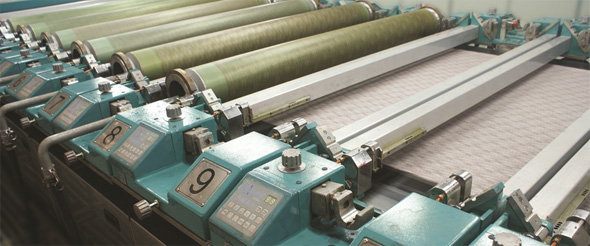
In the accompanying image, you can observe a rotary printing apparatus. Rotary printing presents a diverse spectrum of print possibilities, necessitating technical expertise and meticulous attention to detail for successful production.

Let us delve into the four principal categories of rotary printing:
Frame Printing
Frame printing represents one of the most prevalent techniques in rotary printing, employing nylon screens with varying degrees of perforation. This method accommodates the application of up to eight distinct colors, with each frame dedicated to a single hue. It can be executed through both manual and digital methodologies. In the digital approach, the design is intricately engraved onto the screen, whereas the manual technique utilizes photolithography.
Cylinder Printing
Cylinder printing is a process akin to painting; however, instead of passing through screens, the fabric traverses metallic cylinders. This technique is predominantly utilized for high-end textiles, as it affords enhanced detail and color precision.
All-Over Printing
This method entails the application of a design across the entirety of the fabric's surface, leaving no gaps or white spaces. Commonly referred to as all-over printing, it is frequently employed for expansive prints or intricate patterns. This technique often proves to be a cost-effective solution for small to medium-sized garments. Nevertheless, due to the comprehensive nature of the design's application, it may necessitate additional care during the cutting and sewing phases to ensure that the design aligns seamlessly.
Sublimation Printing
This method entails the transfer of an image from offset paper to fabric through the application of a heat press. Upon the introduction of heat to the paper, the ink is vaporized and adheres to the fibers of the fabric, resulting in a vivid and durable print.
While this process can be applied to a diverse array of textiles, it is crucial to emphasize that it is most efficacious on materials containing at least 50% polyester. Furthermore, sublimation printing facilitates a broader spectrum of colors and designs, including the incorporation of photographic imagery.
Rotary vs. Digital Printing: What Distinguishes Them?
Rotary printing involves the mechanized application of a design onto fabric using cylindrical rollers. In contrast, digital printing and rotary printing represent two distinct methodologies for fabric design creation, each possessing unique attributes.
Although digital printing does not necessitate the use of cylinders, it is generally more costly due to the expense associated with ink and machinery, which can be up to three times more than alternative printing techniques.
Despite its elevated cost, digital printing presents several advantages over the rotary method. For example, it is a more environmentally sustainable choice, as it produces less pollution throughout the printing process.
Moreover, digital printing is particularly advantageous for smaller production runs, as it offers enhanced design flexibility and expedited turnaround times.
However, it is crucial to recognize that not all textiles are appropriate for digital printing. Certain fibers lack adequate ink retention and may fail to yield the desired outcomes.
Consequently, it is essential to meticulously choose the fabric and printing technique to ensure the most favorable results.

Advantages and Disadvantages of Rotary Printing
Like any printing technique, rotary printing presents its own set of benefits and drawbacks.
By comprehending these aspects, you can more effectively evaluate whether it aligns with your requirements.
Below are some of the advantages and disadvantages of rotary printing that warrant your consideration:
Advantages
Rotary printing can enhance garment manufacturing by making it more efficient, quicker, and of superior quality. A primary advantage lies in the utilization of pre-selected designs on cylinders, which simplifies the printing process and ensures uniform results.
Here are some additional advantages:
Efficient Production of Large Volumes
Rotary printing is exceptionally adept at producing fabrics in substantial quantities. This method is highly efficient, resulting in significant time and cost savings, making it an optimal choice for high-volume garment manufacturing.
Customizable Design Variations
With rotary printing, it is feasible to generate variations based on the cylinder for the same design. This capability allows for enhanced customization and flexibility throughout the printing process. Furthermore, up to eight hues can be incorporated into a single print, offering greater design possibilities for apparel manufacturers.
Disadvantages
While rotary printing boasts numerous advantages, it is not without its drawbacks. Primarily, it can be one of the costliest printing methods, necessitating a considerable financial investment for setup and production.
Moreover, the process may contribute to environmental pollution, leading to additional costs. Additionally, there are constraints on the number of colors that can be utilized in rotary printing.
Increased financial commitment for small enterprises
Rotary printing can be prohibitively costly for modest apparel manufacturers, as the expense per unit escalates with reduced production volumes. Given the necessity for pre-fabricated cylinders, the underutilization of these cylinders can lead to substantial financial burdens. Consequently, alternative printing techniques may prove to be more advantageous for smaller enterprises.
Elevated ecological footprint
Rotary printing is associated with considerable consumption of water, chemicals, and energy resources. The technique necessitates a distinct screen for each hue in the design, thereby exacerbating the overall resource utilization. This renders it less environmentally sustainable in comparison to other printing methodologies.

Fabrics Suitable for Rotary Printing
Rotary printing is an exceptionally adaptable technique that can be employed on a diverse array of textiles and sectors, including:
- Casual apparel
- Lingerie
- Activewear
- Children's garments
- Sleepwear
- Bedding
- Swim attire
- Curtains
- General home decor items
This method provides extensive versatility regarding fabric selection, rendering it an optimal choice for numerous industries and applications.
Achieve High-Precision Prints with Audaces Digital Solutions
Rotary printing: Audaces 3D software interface.
With the state-of-the-art technology provided by Audaces machinery and systems, you can attain enhanced precision and efficiency throughout your production workflow.
Audaces solutions enable you to prepare and digitally simulate your prints, ensuring that the final product aligns perfectly with your precise specifications.
In summary, rotary printing is a sophisticated printing technique that can be utilized across a diverse range of fabrics, rendering it an ideal choice for numerous segments within the fashion industry.
By employing meticulously chosen image cylinders, this method facilitates a more efficient and streamlined production process while enhancing the overall quality within the sector.
What is silk screen printing?
How to remove duct tape residue?
Related Article


