
Solar Squeegee: The Essential Tool for High-Precision Solar Cell Screen Printing
Solar Squeegee: The Essential Tool for High-Precision Solar Cell Screen Printing
The global solar industry continues to expand rapidly as demand for renewable energy grows. Behind every high-efficiency photovoltaic (PV) module lies a highly controlled manufacturing process where precision is critical. One often overlooked but indispensable component in this process is the solar squeegee.
In solar cell production, even minor inconsistencies in screen printing can affect conductivity, power output, and overall cell performance. This is why manufacturers rely on specialized solar screen printing squeegees designed to deliver consistent pressure, precise paste transfer, and long service life.
This guide explores what a solar squeegee is, how it works, why it matters in photovoltaic manufacturing, and how to choose the right one for your production line.
What Is a Solar Squeegee?
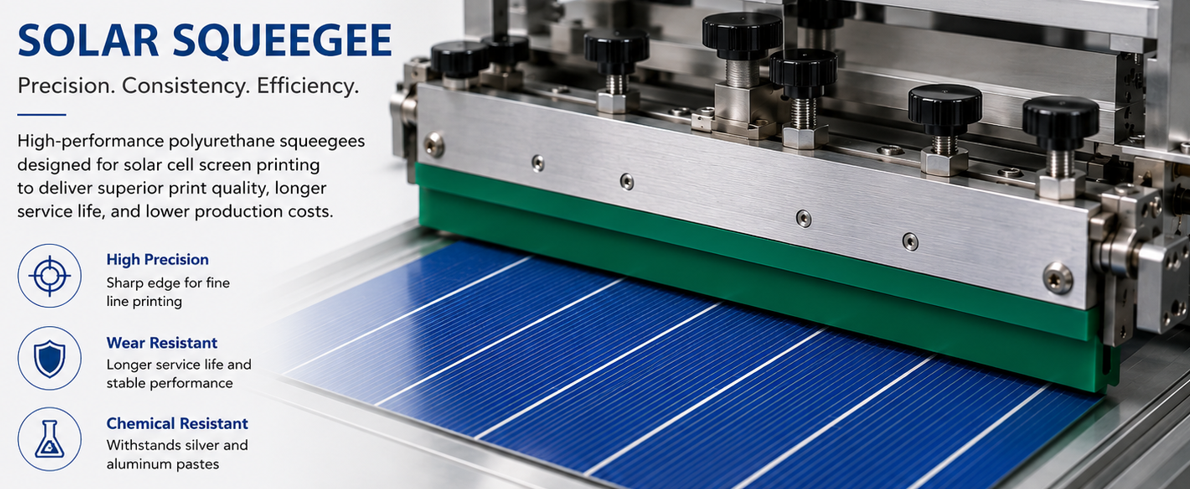
A solar squeegee is a specialized polyurethane blade used in the screen-printing process of photovoltaic cells.
Its primary function is to force conductive pastes through a precision screen mesh onto the surface of a solar wafer. These conductive patterns form the electrical pathways that allow solar cells to collect and transmit energy efficiently.
Unlike conventional screen-printing squeegees used for textiles or graphics, solar squeegees are engineered for:
- Ultra-high dimensional accuracy
- Consistent printing pressure
- Excellent wear resistance
- Chemical resistance to silver and aluminum pastes
- Minimal deformation during continuous production
The quality of the squeegee directly impacts the accuracy of printed grid lines, paste consumption, and cell conversion efficiency.

Why Screen Printing Is Critical in Solar Cell Manufacturing
Screen printing remains one of the most widely used methods for manufacturing crystalline silicon solar cells.
The process is responsible for depositing:
Front-Side Silver Electrodes
Silver paste is printed to create the fine fingers and busbars that collect electrical current.
Rear Aluminum Layer
Aluminum paste is printed on the backside of the wafer to form the back surface field.
Rear Silver Contacts
Additional conductive pathways are created to improve electrical performance.
Because these printed structures are extremely fine, the printing process must achieve exceptional accuracy.
Even slight variations can result in:
- Increased electrical resistance
- Reduced power output
- Poor adhesion
- Higher defect rates
- Increased material waste
A high-quality solar squeegee helps maintain consistent print quality throughout long production runs.
How a Solar Squeegee Works
The screen-printing process for solar cells involves several coordinated components:
- Solar wafer
- Screen mesh
- Conductive paste
- Printing machine
- Solar squeegee
During printing, the squeegee moves across the screen under controlled pressure.
The blade:
- Shears the conductive paste
- Forces paste through screen openings
- Creates uniform printed patterns
- Removes excess paste from the screen surface
The interaction between squeegee hardness, angle, pressure, and speed determines the final print quality.
Key Characteristics of a High-Quality Solar Squeegee
Precision Edge Geometry
The edge profile of the squeegee plays a major role in print definition.
A precision-ground edge ensures:
- Uniform paste deposition
- Sharp line resolution
- Reduced smearing
- Improved repeatability
Poorly manufactured edges can lead to inconsistent printing and reduced production yields.
High Wear Resistance
Solar manufacturing often operates 24 hours a day with minimal downtime.
The squeegee must withstand:
- Continuous friction
- High-speed printing cycles
- Abrasive conductive pastes
Premium polyurethane compounds provide excellent wear resistance while maintaining edge stability.

Consistent Hardness
Hardness directly affects paste transfer and print quality.
Common hardness ranges include:
| Hardness | Typical Application |
|---|---|
| 70 Shore A | Thick paste deposits |
| 75 Shore A | Standard PV printing |
| 80 Shore A | Fine line printing |
| 85 Shore A | Ultra-high precision applications |
Stable hardness ensures consistent printing performance throughout the life of the blade.
Chemical Resistance
Silver and aluminum pastes contain chemical compounds that can degrade inferior materials.
A high-performance solar squeegee should resist:
- Solvents
- Conductive pastes
- Cleaning chemicals
- Production contaminants
This helps extend service life and maintain print quality.
Why Polyurethane Is the Preferred Material
Most solar industry squeegees are manufactured from premium polyurethane.
Compared with rubber alternatives, polyurethane offers several advantages:
Superior Abrasion Resistance
Polyurethane lasts significantly longer under demanding production conditions.
Better Shape Retention
The blade maintains its geometry even after extended use.
Higher Printing Accuracy
Stable blade performance contributes to consistent print quality.
Reduced Downtime
Longer service life means fewer blade changes and less production interruption.
For these reasons, polyurethane has become the industry standard for photovoltaic screen-printing applications.
Common Solar Cell Printing Applications
Monocrystalline Solar Cells
Monocrystalline cells require highly precise electrode patterns.
Solar squeegees help achieve:
- Fine finger lines
- Consistent busbars
- Uniform paste thickness
PERC Solar Cells
Passivated Emitter Rear Contact (PERC) technology demands tighter process control.
High-performance squeegees support:
- Reduced paste consumption
- Improved line definition
- Higher conversion efficiency
TOPCon Solar Cells
TOPCon technology is becoming increasingly popular due to its higher efficiency potential.
Printing requirements are even more demanding, making precision squeegee selection critical.
HJT Solar Cells
Heterojunction solar cells require ultra-fine printing processes.
Advanced solar squeegees help maintain:
- Thin conductive lines
- Precise registration
- High yield rates
Factors to Consider When Choosing a Solar Squeegee
Selecting the right solar squeegee involves more than simply choosing a blade size.
Blade Hardness
Different solar technologies may require different hardness levels.
Factors include:
- Paste viscosity
- Screen mesh count
- Printing speed
- Desired line width
Blade Dimensions
The blade must match the printing machine specifications.
Consider:
- Width
- Thickness
- Length
- Edge profile
Incorrect dimensions can negatively affect printing consistency.
Edge Type
Common edge profiles include:
- Square edge
- Sharp edge
- Rounded edge
- Customized edge profiles
Most photovoltaic applications use precision-ground sharp edges for maximum accuracy.
Material Quality
Not all polyurethane compounds are equal.
Premium formulations provide:
- Longer service life
- Better abrasion resistance
- Stable hardness
- Consistent performance
Manufacturing Precision
High-quality solar squeegees should be manufactured with strict dimensional tolerances.
This ensures:
- Accurate installation
- Uniform pressure distribution
- Repeatable print quality
How Solar Squeegees Impact Production Costs
Although the squeegee represents a small portion of overall manufacturing expenses, it can significantly influence production efficiency.
Reduced Paste Consumption
Better paste transfer efficiency lowers material waste.
Considering the high cost of silver paste, even small savings can generate substantial cost reductions.
Higher Yield Rates
Consistent printing quality reduces defective cells.
Benefits include:
- Lower scrap rates
- Increased productivity
- Improved profitability
Less Downtime
Long-lasting blades require fewer replacements.
This minimizes:
- Production interruptions
- Maintenance costs
- Labor requirements
Better Energy Conversion Efficiency
High-quality printed electrodes contribute to better electrical performance.
This can help manufacturers produce higher-value solar modules.
Maintenance Tips for Solar Squeegees
Proper maintenance can significantly extend blade life.
Clean After Each Production Run
Remove residual paste immediately after use.
Avoid Excessive Pressure
Overloading the blade accelerates wear and can reduce print quality.
Inspect Edges Regularly
Check for:
- Nicks
- Wear
- Deformation
- Uneven edges
Replace damaged blades promptly.
Store Properly
Store squeegees in a clean, dry environment away from direct sunlight and excessive heat.
OEM and Custom Solar Squeegee Solutions
Many photovoltaic manufacturers require customized squeegee solutions.
Custom options may include:
- Special hardness levels
- Custom dimensions
- Unique edge profiles
- Color coding
- Private labeling
- OEM packaging
Working with an experienced manufacturer can help optimize performance for specific production processes.
Future Trends in Solar Screen Printing
As solar cell technology evolves, screen-printing requirements continue to become more demanding.
Industry trends include:
Finer Grid Lines
Manufacturers are reducing line widths to improve efficiency.
Lower Silver Consumption
Reducing paste usage lowers production costs.
Higher-Speed Production
Modern production lines require blades capable of maintaining accuracy at higher printing speeds.
Advanced Cell Technologies
TOPCon, HJT, and future cell designs demand increasingly precise printing performance.
These trends will continue to drive demand for high-performance solar squeegees.
Why Partner with a Professional Solar Squeegee Manufacturer?
Choosing a reliable supplier offers several advantages:
- Consistent product quality
- Stable polyurethane formulations
- Precision manufacturing
- Technical support
- Custom OEM solutions
- Fast delivery
- Long-term supply reliability
For photovoltaic manufacturers, a trusted squeegee supplier becomes an important partner in maintaining production quality and competitiveness.
Conclusion
A solar squeegee may appear to be a simple component, but its impact on photovoltaic manufacturing is substantial. From paste transfer accuracy and printing consistency to material consumption and cell efficiency, the right squeegee contributes directly to production performance and profitability.
As solar cell technologies continue advancing toward higher efficiency and finer conductive patterns, the demand for precision-engineered photovoltaic screen-printing squeegees will only increase.
Manufacturers seeking stable production, lower operating costs, and higher product quality should carefully evaluate blade material, hardness, edge geometry, and supplier expertise when selecting a solar squeegee solution.
FAQ
What is a solar squeegee used for?
A solar squeegee is used in photovoltaic screen printing to transfer conductive pastes through a screen onto solar wafers, creating the electrical circuits required for energy generation.
What material is best for solar screen-printing squeegees?
Premium polyurethane is widely considered the best material due to its excellent wear resistance, dimensional stability, and chemical resistance.
How often should a solar squeegee be replaced?
Replacement frequency depends on production volume, paste type, and operating conditions. Regular inspection helps determine the optimal replacement schedule.
What hardness is commonly used for solar cell printing?
Most photovoltaic applications use polyurethane blades ranging from 70 to 85 Shore A, with 75–80 Shore A being common for standard production.
Can solar squeegees be customized?
Yes. Many manufacturers offer OEM customization, including dimensions, hardness, edge profiles, colors, and private-label packaging.
How does a solar squeegee affect solar cell efficiency?
A high-quality squeegee improves print accuracy and conductive line consistency, which can contribute to better electrical performance and higher solar cell conversion efficiency.
What Is Digital Fabric Printing?
What Are Differential Adhesive Tapes Use For?
Related Article


