
Different kinds of screen printing mesh Usage
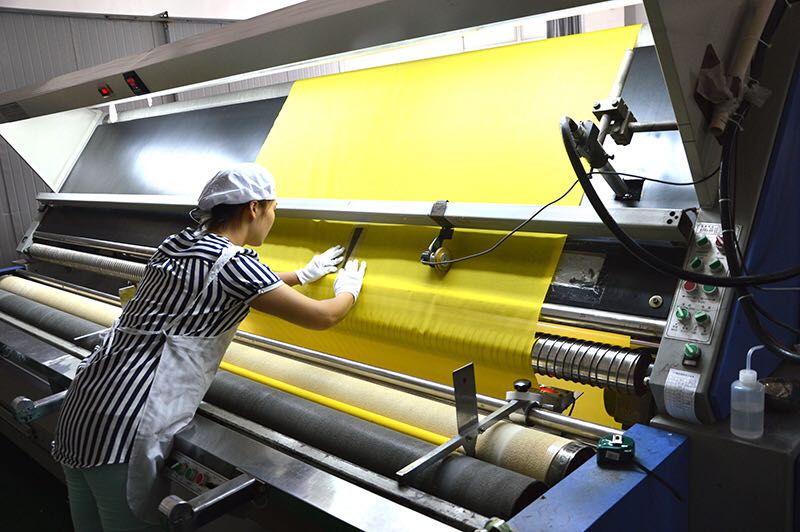
Different kinds of screen printing mesh Usage
Silk screen printing, a technique transferring ink onto various substrates (e.g., paper, fabric, metal, plastic) through a mesh screen, showcases versatility, vibrant color production, and suitability for small to large-scale projects. It's widely used for posters, apparel designs, signage, and more, offering print options on textiles (like cotton, polyester, nylon), paper, glass, metal, plastics, and other materials. Essential products include inkjet film, screen printing mesh, emulsion, screen printing squeegees, ink, printing substrate, drying equipment and cleaning tools, etc..
In screen printing process, the choice of screen printing mesh is vital. Screen printing mesh, as a core part in screen printing process, its quality and characteristics directly influence the final result of the screen printing. There are also many choice for screen printing mesh. Expect for the most common one, polyester mesh, nylon mesh and metal mesh are also used in screen printing. Both them have strengths and weakness. Today, let’s know more about the screen printing mesh.
Polyester mesh is the most widely-use mesh in screen printing technology. It is very familiar to most workers in the screen printing industry. Polyester is a synthetic polymer formed by a chemical reaction involving alcohol, carbolic acid, and a petroleum byproduct. The resulting fibers can be stretched and aligned to form yarn.
Polyester screen printing mesh is suitable for general walking walkway line printing factories, uniform printing factories, glove line printing, organic glass, plastic panel line printing, etc., and also for printed circuit boards that require printing dimensional accuracy. Polyester screen printing mesh has the advantages of solvent resistance, high-temperature resistance, water resistance and chemical resistance. When subjected to high external pressure, the physical properties of polyester mesh remain stable and its tensile strength is low. The drawback is that it has poor wear resistance compared with nylon wire mesh.

Nylon is a synthetic plastic created by extracting and heat treating carbon-based compounds from organic matter. It is capable of being extruded into strands of various sizes and thicknesses to suit different applications. Nylon fibers can be knitted into durable mesh suitable for different filtering and screen printing applications.
Nylon screen printing mesh features high strength, wear resistance, chemical resistance, water resistance, elasticity, uniform wire diameter and smooth surface, so its ink permeability is also extremely excellent. The drawback is that the nylon mesh has a high stretch-ability. For a period of time after the screen printing screen was laid, the tension decreased, the screen became loose and the precision declined. Therefore, it is not suitable for wiring substrates and the like that require high dimensional accuracy.
Metal mesh is not very common because it is more expensive than polyester mesh and nylon mesh. Stainless steel screen printing mesh is made by stainless steel material. The characteristics of stainless steel screen printing mesh are good wear resistance, high strength and low technical elongation. Due to the fine wire diameter, the ink has good permeability and the mechanical and chemical properties of the screen are stable which ensure the stability of the dimensional accuracy. Its shortcomings are poor elasticity and high price. The screen cannot be restored after being stretched. Stainless steel screens are suitable for high-precision printing on substrates and integrated circuits, etc. Metal screen printing mesh has occupied an important position in the screen printing industry due to its unique physical properties and printing performance, and has become the preferred material for many screen printing tasks.

In choosing suitable screen printing mesh, we should take material of substrate, ink characteristics, the fineness of the design and any other factors into consideration. Screen printing technology is suitable for a variety of substrates, such as fiber fabrics, paper products, etc. Different types of substrates require different types of screen printing mesh. For instance, for cylindrical containers, nylon mesh with good elongation is usually selected, while for substrates with high surface roughness, low-mesh screen mesh is more suitable than other choice. For patterns with high requirements for printing precision and size, such as microelectronic components, stainless steel screen printing mesh and polyester mesh should be used, and high-mesh should be selected to achieve high reproduction fineness. Hope this will be helpful when you are facing the choice of screen printing mesh.
For more information about screen printing, please contact at +86 15097355251
DTF VS SCREEN PRINTING
The guide of choosing screen printing squeegee
Related Article


