
Advantages of screen printing
Advantages of screen printing
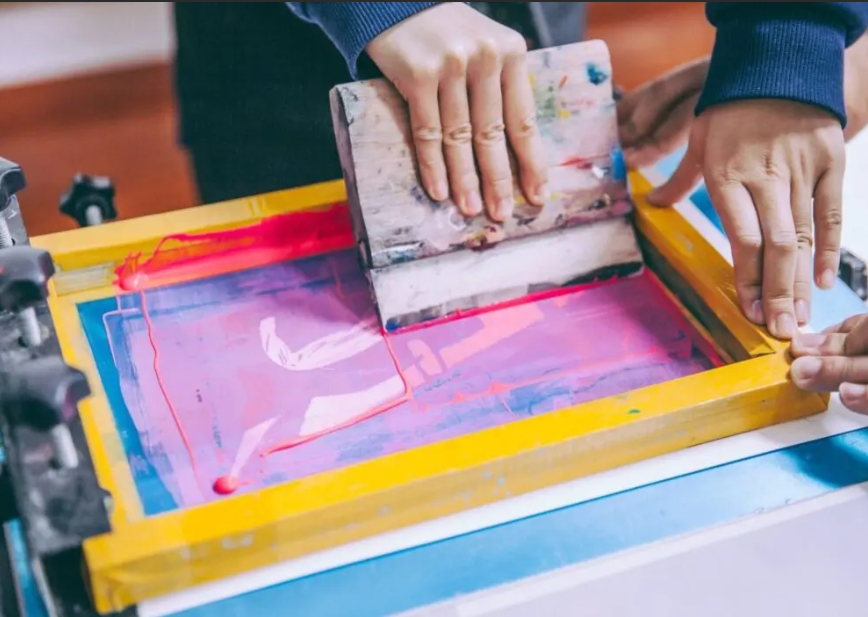
Silk screen printing, a technique transferring ink onto various substrates, such as paper, fabric, metal, plastic, through a mesh screen, showcases versatility, vibrant color production, and suitability for small to large-scale projects.
It's widely used for posters, apparel designs, signage, and more, offering print options on textiles , like cotton, polyester, nylon, paper, glass, metal, plastics, and other materials. Essential products include screens, emulsion, light source, squeegees, ink, printing substrate, screen printing press, cleaning supplies, drying equipment, and design software or film positives.
Screen printing can be printed on many kinds of materials. Unlike traditional printing methods, this technology can achieve high-quality printing on flat, curved and even irregular surfaces. Whether it is cylindrical containers, spherical objects or textured substrates, clear printing effects can be achieved, greatly expanding the application scenarios. The screen printing screen is soft and elastic. This characteristic makes screen printing not only suitable for printing soft items such as paper and fabric, but also for hard items such as glass and ceramics, demonstrating its wide range of applications.

Multiple types of inks can be used on screen printing process. Whether it is oil-based, water-based, synthetic resin emulsion type or powder ink, they can all be well applied in the screen printing process, which greatly expands their printing range and adaptability. In addition, the method of mixing screen printing ink is simple. For instance, light-resistant pigments can be directly added to the ink for mixing, which is another major feature of screen printing.
The ink layer of screen printing is thick and has strong covering power, which makes the printed matter have better color saturation and visual effect, and enhances the artistic expressiveness and ornamental value of the printed matter. That makes the printed patterns have extremely strong covering power. This characteristic not only ensures the presentation of vivid colors on dark substrates, but also endows printed materials with a longer service life and better wear resistance.
The ink layer thickness of screen printing far exceeds the above-mentioned thicknesses, usually reaching around 30 microns. For thick screen printing specifically used in circuit board production, the ink layer thickness can reach up to 1000 microns. When using foaming ink to print Braille dots, the ink layer thickness can reach 1300 microns after foaming. Screen printing features thick ink layers, rich texture and strong three-dimensional effect, which are unmatched by other printing methods. Screen printing can not only be used for single-color printing, but also for overprinting and halftone color printing.
Screen printing technology is not limited by the printing area and can easily complete the printing tasks of large-scale projects such as huge advertisements and building facades. Compared with other printing methods, the production efficiency has been significantly improved on the premise of ensuring quality. Generally, the maximum area size that can be printed by offset printing, letterpress printing and other printing methods is the full sheet size. If it exceeds the full sheet size, it is restricted by the mechanical equipment. Screen printing can be used for large-scale printing. Nowadays, the maximum size of screen printed products can reach 3 meters by 4 meters, or even larger.

By optimizing the ink formula and printing process, a strong combination between the ink and various materials has been achieved. Even in high-temperature, high-humidity or chemically corrosive environments, the printed patterns can remain intact and not fall off.
Screen printing technology not only excels in printing quality, but also has obvious cost advantages. Screen printing equipment is simply designed and easy to operate, making the printing and plate-making process simple and economical. What is more worth mentioning is that the production cost of screen printing plates is not high and they can be reused. Overall, screen printing is still a very economical and efficient printing method. The printing effect of screen printing is extremely excellent. It is wear-resistant, water-resistant, oil-resistant, and resistant to chemicals, and is durable.
Screen printing, as a special printing process, has many characteristics and advantages. It has high-precision color printing capabilities, can be applied to the surfaces of various materials, and features good wear resistance and environmental friendliness. Meanwhile, screen printing also has advantages such as high production efficiency and economy. Therefore, screen printing has been widely applied in many industries.
For more details, please contact at +86 15097355251
What is screen printing: How it works?
Tips on choosing screen printing accessories
Related Article


